
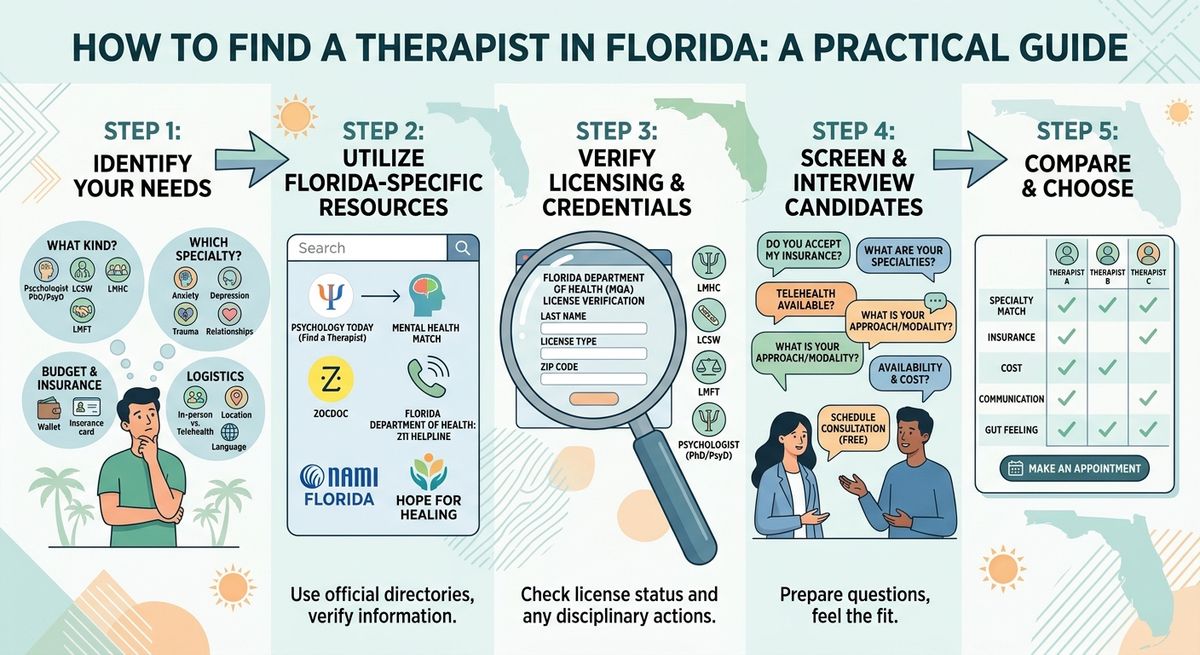
Finding a therapist in Florida can feel overwhelming. Between licensing types, therapy styles, insurance questions, and the simple challenge of knowing what you need, many people stall before they book a first appointment. This guide walks you through the process step by step.
1. Get Clear on Why You’re Looking for Therapy
You don’t need a diagnosis or a crisis to start therapy. Most people begin because something feels stuck, overwhelming, or hard to understand alone. Common reasons include:
- Anxiety, low self-worth, or repeating emotional patterns
- Past experiences that still affect how you feel today
- Communication problems or distance in a relationship
- Conflict, changing roles, or stress in your family
If you’re unsure what you’re experiencing, that’s fine. A good therapist will help you sort it out. At Thrive With Therapy, the first step is a conversation about what you’re going through and whether therapy feels like the right next step.
2. Understand the Types of Therapists in Florida
Florida licenses several kinds of mental health professionals, including:
- Licensed Marriage and Family Therapists (LMFT), who focus on relationships, family systems, and emotional patterns
- Licensed Clinical Social Workers (LCSW)
- Licensed Mental Health Counselors (LMHC)
- Psychologists, who may also provide psychological testingc
An LMFT is a strong choice if your concerns involve relationships, family, or patterns that show up across your life. Vanessa M. Sierra, LMFT has more than 20 years of experience working with adults, couples, families, and children.
3. Match the Type of Therapy to Your Needs
Therapists specialize, so look for one whose focus fits your situation.
Individual therapy. If something feels stuck or difficult to understand on your own, individual therapy offers a space to work on self-worth, emotional patterns, and healthier responses.
Couples therapy. If you care about each other but keep falling into the same arguments, couples therapy can help with communication, emotional needs, and attachment patterns.
Parenting and family therapy. If your family is dealing with conflict, changing roles, or the challenges of raising children, parenting and family therapy can help you build healthier dynamics.
Trauma-focused therapy. If past experiences still shape how you react or connect with others, trauma-focused therapy works on emotional regulation and patterns rooted in the past.
You can browse all of these on the services page.
If trauma is your main concern, it helps to know the approaches available. Our article Understanding EMDR: How Eye Movements Heal Trauma explains how EMDR helps the brain reprocess painful memories. You may also like The Body Keeps the Score: Exploring Somatic Experiencing, which looks at how the body holds stress.
4. Verify the Therapist’s License
Before booking, confirm that the therapist is licensed in Florida. You can look up any provider’s license, status, and any disciplinary history through the Florida Department of Health’s license verification tool. This matters for online therapy too: if you live in Florida, your therapist should generally be licensed to practice in the state.
5. Decide Between Online and In-Person Sessions
Florida is a big state, and commutes can be long. Many therapists now offer both formats.
- In-person suits people who want a dedicated, private space away from home.
- Online suits busy schedules, travel, or limited local options.
Thrive With Therapy offers online and in-person sessions, with an office in Coral Gables and support for clients across South Florida.
6. Ask About Fees, Insurance, and Logistics
Before your first session, ask:
- What is the session fee, and how long is each session?
- Do you accept insurance, or provide a receipt you can submit for out-of-network reimbursement?
- What is your cancellation policy?
- How often would we meet?
Many of these answers are on the FAQ page. If yours isn’t there, contact us directly.
7. Book a Consultation and Trust Your Gut
Research shows that the relationship between you and your therapist is one of the strongest predictors of progress. A first conversation is the best way to judge fit. Notice whether you feel heard, whether the therapist explains their approach clearly, and whether you feel safe being honest.
You don’t need to have everything figured out first. You can book a consultation to talk through what you’re experiencing and what you’re looking for.
8. Start Helping Yourself While You Search
Searching for a therapist can take time, and you don’t have to wait to begin. The free resource library includes printable guides and reflection tools. If stress feels overwhelming right now, try 4 Practical Daily Grounding Techniques for steadying yourself in the moment. For more perspective on relationships, emotions, and parenting, browse the Insights blog.
If you are in crisis or having thoughts of harming yourself, call or text 988 (the Suicide & Crisis Lifeline) or call 911.
Final Thoughts
The right therapist is someone who is licensed, experienced with your concerns, and a person you feel safe with. Start with what you need, check credentials, ask practical questions, and trust how the first conversation feels.
If you’re ready to take the next step, meet Vanessa or book a consultation with Thrive With Therapy. You can also call 954-635-0234.